The Science Behind Personality Tests: Are They Actually Accurate?
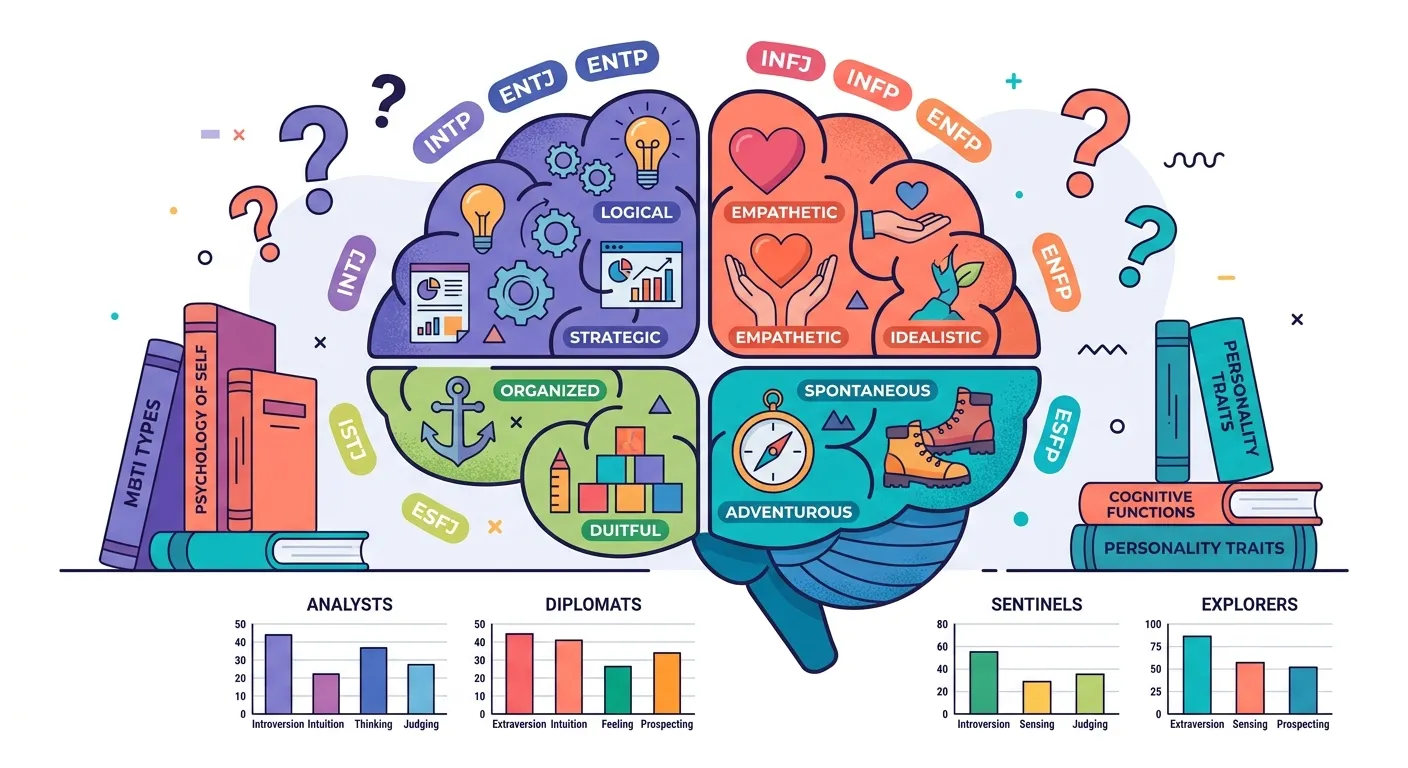
In 2023, the MBTI assessment was taken over 3.5 million times. The Big Five quietly powers hiring decisions at Fortune 500 companies, military personnel evaluations, and clinical diagnoses. The Enneagram has its own ecosystem of books, Instagram accounts, and relationship advice subreddits. Every year, a fresh wave of people discovers their type and feels, with startling clarity, that they have finally been seen.
Here's why this matters more than you think: the question is not whether personality tests feel accurate. They almost always do. The interesting question is what that feeling tells us about us — and what it does not.
What Personality Tests Are Actually Measuring
Before evaluating accuracy, you need to know what a personality test is even trying to do. Most mainstream tests work from a model called trait theory — the idea that personality can be described as a collection of stable tendencies that vary across individuals. Your level of Extraversion, for example, predicts how much you seek social stimulation. Your Conscientiousness score predicts how organized, persistent, and goal-directed you tend to be.
The Big Five (also called OCEAN — Openness, Conscientiousness, Extraversion, Agreeableness, Neuroticism) emerged from decades of factor analysis on how people describe themselves and others. It is not a theory someone invented; it is a statistical summary of how personality traits cluster together in practice. This matters for the accuracy question: the Big Five's dimensions were found in the data, not imposed on it.
The MBTI takes a different approach. It was developed by Isabel Briggs Myers and her mother Katharine Cook Briggs based on Carl Jung's type theory — a theoretical model, not a data-driven one. The 16 types are combinations of four binary dimensions: Introvert/Extrovert, iNtuiting/Sensing, Feeling/Thinking, Perceiving/Judging. The problem with binaries is that most people score near the middle on most dimensions — which means a tiny measurement fluctuation flips your label.
The Retesting Problem: Why Your Type Changes
You've probably noticed this, or know someone who has: take the MBTI twice, get two different answers. This is not a bug. It is an accurate reflection of how the test works.
A 1993 study by David Pittenger found that roughly 50% of respondents receive a different 4-letter type when retested after just 5 weeks. The dimensions with the worst test-retest reliability are Judging/Perceiving and Feeling/Thinking — the very ones most people feel most certain about.
Here's the structural reason: MBTI scores you on a continuous scale (say, 55% Introvert) but then converts that to a binary (Introvert). If you score 52% Introvert on Monday and 48% Introvert on Friday — possibly because you're tired, in a different mood, or answered a few questions differently — you get opposite labels. The underlying personality has not changed. The label has.
This is not a fatal flaw if you understand what the test is for. Myers and Briggs designed the MBTI as a tool for self-reflection, not clinical diagnosis or prediction. The problem starts when companies use it for hiring, or when people use their type to foreclose options (“I'm a P, I could never be organized enough to run a project.”).
Take the What Type of Learner Are You? quiz to explore one dimension of cognitive style — and notice whether the result feels like a constraint or a starting point.
The Big Five: Where Predictive Power Actually Lives
The Big Five is where the scientific evidence gets genuinely interesting. A landmark meta-analysis by Barrick and Mount (1991) analyzed 117 studies involving 23,994 participants and found that Conscientiousness predicts job performance across all occupational groups with a corrected correlation of r = 0.22 — modest by social science standards, but robust and consistent.
More striking: a 2007 longitudinal study (Roberts et al., n=4,365) found that Conscientiousness scores at age 18 predicted occupational attainment, relationship stability, and physical health outcomes at age 40 better than childhood socioeconomic status or IQ. Not dramatically better — these correlations are in the r = 0.20–0.35 range — but reliably better, across multiple decades of life.
This is the version of personality measurement that behavioral economists and epidemiologists actually use. It does not give you a tidy type label; it gives you a profile of where you fall on five continuous dimensions, each with real-world implications.
The Big Five also reveals something uncomfortable: Neuroticism — the tendency toward negative emotions, anxiety, and emotional instability — is among the strongest predictors of life dissatisfaction, relationship problems, and mental health challenges. Knowing you score high on Neuroticism is genuinely useful clinical information. It does not mean you are broken; it means you have a specific vulnerability that responds well to specific interventions (particularly CBT and mindfulness-based practices).
Why Tests Feel True Even When They Are Not
In 1948, psychologist Bertram Forer gave his students a personality test and then handed each person an individualized analysis. The students rated their personalized descriptions as 85% accurate on average. They were impressed. Then Forer revealed the twist: every student had received exactly the same description, copied from an astrology column.
This is the Barnum–Forer effect: we accept vague, flattering personality descriptions as uniquely accurate because we are motivated to find self-confirming information and because the descriptions are designed to be broad enough to apply to almost anyone. (“You have a strong need for other people to like and admire you” — who does not?)
Modern personality tests reduce this effect by offering specific type combinations (16 MBTI types, 9 Enneagram types) rather than a single profile — but they cannot eliminate it. The descriptions for most types are written to be relatable and validating, which means almost anyone could find themselves in almost any type description if they are motivated to look.
This is not evidence that personality tests are worthless. It is evidence that the feeling of recognition a test produces should not be mistaken for scientific validation. The test might be accurate. The feeling of accuracy does not tell you whether it is.
What to Actually Do With Your Results
Here's the spectrum, not the binary: personality tests are more useful than horoscopes and less informative than a good therapist. Where they genuinely help:
- Self-reflection prompts. A result that says you score high on Openness to Experience is a useful starting point for thinking about what environments and roles you find energizing. It is not a career verdict.
- Vocabulary for conversations. Sharing personality profiles in relationships and teams gives people a shared language for discussing differences that might otherwise go unnamed. “I'm higher in Introversion” communicates something useful in a way that “I'm just different from you” does not.
- Identifying growth areas. If your Conscientiousness profile is low and your life outcomes reflect that, the profile is giving you information you can act on.
What they do poorly: predicting performance in specific roles, determining compatibility, or telling you what you are “meant to do.” The research does not support using personality type as a hiring screen, and the most comprehensive review of MBTI use in organizations (Pittenger, 2005) concluded that the evidence base does not justify employment selection decisions.
Curious which cognitive patterns show up for you? Try the Career Path Quiz to explore how your natural tendencies map to different work environments — or the Travel Style Quiz for a lighter take on how your personality shows up in low-stakes choices.
The Three Tests, Ranked by Scientific Rigor
This is not an attack on any of these tools — it is a map of what they are good for.
| Test | Scientific Basis | Test-Retest Reliability | Best Use |
|---|---|---|---|
| Big Five (OCEAN) | Data-driven (factor analysis) | r = 0.70–0.80 over 4 years | Research, prediction, self-growth |
| MBTI | Theory-driven (Jungian types) | ~50% retype at 5 weeks | Self-reflection, team communication |
| Enneagram | Limited peer-reviewed validation | Variable; type descriptions overlap | Therapy, spiritual development |
The Part Nobody Talks About: Types vs. Dimensions
Here's the connection nobody makes explicit in most personality test explainers: the MBTI gives you types, and the Big Five gives you dimensions — and that difference is not cosmetic. It is the core reason for the scientific divergence.
When you distribute something that actually varies continuously (like Introversion–Extraversion) into binary buckets, you lose information. A person who scores 52% Extrovert and a person who scores 90% Extrovert both get labeled “Extrovert,” but they are meaningfully different in the ways that actually matter for predicting behavior.
This is why psychologists almost universally prefer dimensional models like the Big Five for research — and why the MBTI's 16-type framework, while narratively satisfying, does not generate the predictive validity that dimensional models do.
Three years from now, the most useful version of personality science will probably not look like any current test — it will likely involve ecological momentary assessment (measuring mood and behavior in real time, across thousands of micro-measurements, rather than one self-report survey). The current tests are the best tools we have right now. They are genuinely better than nothing. And they are nowhere near the ceiling.
In the meantime, try the Movie Genre Personality Quiz for a Lena-approved example of using type categories as a lens, not a verdict — or see how your pop culture pattern-recognition stacks up with the 90s Pop Culture Trivia.
The Bottom Line
The science behind personality tests is a spectrum, not a binary. The Big Five has genuine predictive validity across cultures and decades. The MBTI has good enough reliability for self-reflection but not for prediction. The Enneagram has a rich tradition and limited peer-reviewed support. All of them are more likely to feel accurate than to be accurate — because the Barnum–Forer effect is operating on every test-taker, whether they know it or not.
This is not a reason to stop taking them. It is a reason to take them with curiosity rather than conviction. Your type is a starting hypothesis, not a conclusion. What you do with it — whether you use it to understand yourself better or to foreclose options before you have tried them — is the part that actually matters.
Frequently Asked Questions
Are personality tests scientifically valid?
It depends on which test and what you mean by 'valid.' The Big Five (OCEAN) model has the strongest scientific support — it reliably predicts job performance, relationship stability, and health outcomes across cultures (Barrick & Mount, 1991; John & Srivastava, 1999). The MBTI has reasonable test-retest reliability for broader type categories (I/E, N/S) but weaker reliability for fine-grained types — roughly 50% of takers get a different 4-letter result when retesting 5 weeks later. The Enneagram lacks large-scale peer-reviewed validation but has a strong therapeutic following. No personality test is perfectly accurate; all are models, and models are simplified maps, not the territory.
Why do I get different MBTI results each time I take the test?
Because most MBTI dimensions are scored on a continuous scale, not a binary. If you score 52% Introvert on one test and 48% Introvert on another, you get flipped labels for the same underlying trait score. Retesting after 5 weeks produces a different 4-letter type for roughly 50% of respondents (Pittenger, 1993). This is not the test malfunctioning — it is showing you that you are near the middle of a dimension, which is actually the most common result. The label changes; your actual personality does not.
Is the Big Five more accurate than the MBTI?
For predictive validity — meaning, for predicting real-world outcomes — yes. Big Five scores predict job performance, academic achievement, relationship longevity, and health behaviors with meaningful correlations (r = 0.15–0.42 across studies). The MBTI was not designed for prediction; it was designed for self-understanding. Both tools measure personality, but they have different purposes. If you want to understand yourself better, either can be useful. If a company is using MBTI to make hiring decisions, that's a misuse of the tool.
Why do personality tests feel so accurate even when they aren't?
This is the Barnum–Forer effect in action. In the 1948 Forer experiment, students rated personality descriptions written for them as 85% accurate on average — but every student received the exact same description. We accept vague, positive personality descriptions as uniquely accurate because we are motivated to find self-confirming information and because the descriptions are broad enough to apply to almost anyone. Personality tests add a layer of specificity (16 types instead of one) that reduces this effect somewhat, but does not eliminate it.
Do personality types actually stay stable over time?
Core traits are relatively stable in adulthood, but not unchanging. Longitudinal studies find that Conscientiousness and Agreeableness tend to increase as people age through their 20s and 30s, while Neuroticism tends to decrease (Roberts et al., 2006, n=92 longitudinal studies). Big Five trait scores show test-retest correlations of r = 0.70–0.80 over 4 years — strong, but not perfect. Major life events (new job, marriage, chronic illness) produce measurable trait shifts. Personality is a tendency, not a fixed destiny.
Should I use my personality type to make major life decisions?
Use it as one input, not a determining factor. There is no personality type that cannot succeed in a given career or relationship — what matters more is skill development, context fit, and motivation. The risk of rigid type-thinking is foreclosing options before you have tried them: telling yourself 'I'm an introvert, so leadership is wrong for me' when leadership skill is learnable regardless of introversion level. Treat your results as a starting conversation about your preferences, not a verdict on your potential.
What is the most accurate free personality test?
For Big Five measurement, the IPIP-NEO (available at ipip.ori.org) is peer-reviewed, free, and widely used in academic research. For the MBTI framework, the official 93-question MBTI assessment through Myers-Briggs.org is more reliable than free knockoffs, but costs $49–$200. Free MBTI-style tests vary widely in reliability. For self-exploration rather than prediction, the most useful test is whatever prompts genuine self-reflection — including the quizzes right here.
Find Out Your Personality Type
Explore your cognitive style, career tendencies, and more with our free quizzes — no email required.
Take the Career Path Quiz →