MBTI vs Enneagram vs Big Five: Which Personality Test Is Most Accurate?
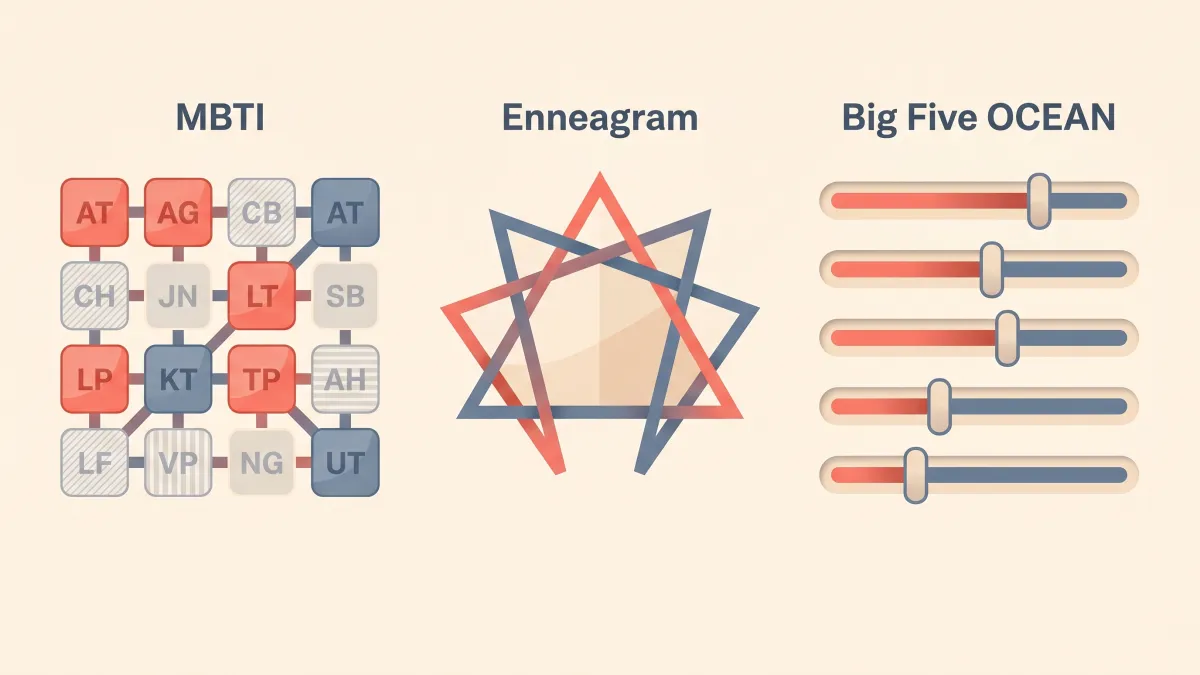
Ask three people what their personality is and you will hear three different alphabets. One says “I'm an INFJ.” Another says “I'm a Type 4.” A third rattles off five percentile scores from a Big Five test. They are all describing the same thing — themselves — using frameworks that disagree about what personality even is and how to measure it.
So which one is right? The honest answer is that they are answering different questions. The MBTI sorts you into a memorable type. The Enneagram digs into your underlying motivation. The Big Five measures where you land on five continuous dimensions. Only one of them holds up under the standards research psychologists actually use — but “most accurate” and “most useful to you” are not always the same test. Here is how the three compare, and how to decide which to trust for what.
The Three Frameworks at a Glance
Before judging accuracy, it helps to know what each test is built from, because their foundations explain almost everything about how they differ.
MBTI (Myers-Briggs Type Indicator) was developed by Katharine Cook Briggs and her daughter Isabel Briggs Myers, drawing on Carl Jung's theory of psychological types. It sorts you across four either/or dimensions — Introversion/Extraversion, Sensing/iNtuition, Thinking/Feeling, Judging/Perceiving — to produce one of 16 four-letter types. It is theory-first: the categories came from Jung's ideas, not from analyzing data.
The Enneagram describes nine interconnected personality types arranged on a nine-pointed figure, each defined by a core motivation, a basic fear, and a characteristic way of coping. Its modern form was assembled in the 1970s by Oscar Ichazo and Claudio Naranjo from older spiritual and philosophical traditions. It is the only one of the three built primarily around why you do things rather than what you do.
The Big Five (also called OCEAN — Openness, Conscientiousness, Extraversion, Agreeableness, Neuroticism) was not invented by anyone in the usual sense. It emerged from decades of statistical analysis — researchers like Lewis Goldberg and, later, Costa and McCrae found that the thousands of words people use to describe personality reliably collapse into the same five clusters. It is data-first, which is exactly why it dominates academic research.
How “Accuracy” Is Actually Measured
When psychologists talk about whether a test is accurate, they mean two specific things. The first is test-retest reliability: if you take it twice, do you get the same answer? The second is predictive validity: does your score actually forecast real-world outcomes like job performance, relationship stability, or health?
These are measurable, and the three frameworks score very differently on them. Big Five trait scores show test-retest correlations of r = 0.70 to 0.80 over four years (Roberts et al., 2006), and predict outcomes with meaningful effect sizes. The MBTI's broad dimensions are decently reliable, but its four-letter type is not — David Pittenger's widely cited 1993 analysis found that roughly 50% of people get a different type when retested after just five weeks. The Enneagram has far less large-scale validation data of either kind, though some studies show its types correlate loosely with Big Five trait combinations.
Curious where you land on the dimensional model that research relies on? The Big Five Personality Quiz gives you a quick read across all five OCEAN traits in about two minutes.
MBTI: Memorable, But It Forces Continuous Traits Into Boxes
The MBTI's greatest strength is also its core weakness. Sorting people into 16 named types makes the results sticky — “INFJ” is a tidy identity people genuinely remember and share. That memorability is why it remains the most-taken personality assessment in the world, with millions of administrations a year.
The problem is the binary. Most people score near the middle of most dimensions, so a small fluctuation in mood or wording flips a label. Someone at 51% Introvert and someone at 95% Introvert both get an “I,” even though they behave very differently — and the person at 51% can become an “E” on a tired Tuesday. The underlying trait never moved; only the label did. The Myers & Briggs Foundation is clear that the tool is for self-understanding and team communication, not hiring, selection, or prediction.
Used the right way, the MBTI is genuinely valuable as a shared vocabulary. Want a quick, modern take on the four-letter framework? The MBTI-Style Personality Quiz maps you to a type and an alignment without pretending it's a diagnosis.
Enneagram: Strong on Motivation, Thin on Evidence
The Enneagram does something the other two largely skip: it centers motivation. A Type 1 (the Reformer) and a Type 3 (the Achiever) might both look highly conscientious from the outside, but the Enneagram says they are driven by very different fears — one by a fear of being corrupt or wrong, the other by a fear of being worthless without achievement. That focus on the “why” is why coaches, therapists, and spiritual directors love it.
Scientifically, though, it is the weakest of the three. There is no large body of longitudinal or predictive-validity research behind it, and the descriptions are broad enough that the Barnum effect — our tendency to accept vague, flattering profiles as uniquely true — does heavy lifting. Some instruments like the RHETI show acceptable internal reliability, and a few studies map the nine types onto Big Five combinations, but it has not earned the research standing the Big Five has. Treat your Enneagram type as a rich hypothesis about your motivations, not a measured fact.
If the motivational angle appeals to you, the Enneagram Type Quiz walks you through the nine types and the core fear and desire behind each. It pairs especially well with a Big Five read — one tells you the “what,” the other the “why.”
Big Five: The Research Standard
The Big Five is the framework working scientists actually use, and the reason is simple: it measures traits as continuous dimensions rather than forcing them into types, so it keeps the information the other models throw away. A landmark meta-analysis by Barrick and Mount (1991) covering 117 studies and 23,994 participants found that Conscientiousness predicts job performance across every occupational group, with a corrected correlation of r = 0.22 — modest by everyday standards, but robust and replicable.
Its dimensions also map onto outcomes that matter. Neuroticism is among the strongest predictors of life dissatisfaction and relationship strain. Openness tracks creativity and tolerance for novelty. And because the model is dimensional, it captures the difference between someone moderately and someone extremely extraverted — a distinction the MBTI's single “E” erases. The trade-off is that the Big Five gives you a profile, not a catchy identity, which is exactly why it never went viral the way the MBTI did.
Side by Side: The Comparison Table
| Framework | Measures | Scientific Support | Best Used For |
|---|---|---|---|
| MBTI | 16 types from 4 binary preferences | ~50% retype at 5 weeks; weak prediction | Self-reflection, team communication |
| Enneagram | 9 types by core motivation & fear | Limited peer-reviewed validation | Therapy, coaching, understanding “why” |
| Big Five | 5 continuous trait dimensions | r = 0.70–0.80 reliability; strong prediction | Research, prediction, growth tracking |
So Which Should You Actually Take?
The framing that trips people up is treating this as a contest with one winner. It is more like choosing a tool for a job. If you want the answer closest to scientific truth — the one that predicts behavior and stays stable over time — take the Big Five. If you want a memorable shorthand to share with a team or a partner, the MBTI is hard to beat. If you want to understand the fear and desire underneath your habits, the Enneagram offers language nothing else does.
Most people get the richest picture by combining them: a Big Five profile for accuracy, an MBTI type for communication, and an Enneagram type for motivation. They overlap enough to cross-check each other and differ enough to fill in each other's blind spots. The one rule worth keeping is the one the research insists on — your result is a starting hypothesis about yourself, never a verdict. No type should ever talk you out of a career, a relationship, or a risk you actually want to take.
If you want the deeper story on why some of these tools predict behavior and others mostly feel true, read the science behind personality tests, which breaks down the Barnum effect and the reliability data in more detail. And if you are weighing which framework fits a specific decision at work, this guide to choosing the right productivity tools over on ToolPilot takes the same “match the tool to the job” approach.
Frequently Asked Questions
Which personality test is the most accurate — MBTI, Enneagram, or Big Five?
By the standard psychologists use — predictive validity and test-retest reliability — the Big Five (OCEAN) is the most accurate. Its trait scores stay stable at r = 0.70 to 0.80 over four years and predict real outcomes like job performance and relationship stability. The MBTI is reasonably reliable for broad dimensions but flips roughly 50% of takers to a different four-letter type after just five weeks (Pittenger, 1993). The Enneagram has the richest descriptive language and a strong therapeutic following but the weakest large-scale peer-reviewed validation. Accurate for what, though, is the real question: the Big Five wins on prediction, while MBTI and Enneagram often win on whether people actually use and remember their result.
Why does my MBTI type keep changing?
Because the MBTI converts continuous traits into binary labels. If you score 52% Introvert one week and 48% the next, you flip from I to E even though your underlying personality has not moved at all. David Pittenger's research found roughly half of people get a different four-letter type when retested after five weeks. The dimensions people feel most certain about — Judging/Perceiving and Thinking/Feeling — are the least reliable. A changing label usually means you sit near the middle of that dimension, which is the most common place to be.
Is the Enneagram scientifically valid?
It has limited peer-reviewed support compared to the Big Five. Some studies find the nine Enneagram types map loosely onto Big Five trait combinations, and a handful of instruments (like the RHETI) show acceptable internal reliability. But there is no large body of longitudinal or predictive-validity research behind it the way there is for the Big Five. The Enneagram's strength is descriptive and motivational — it focuses on the 'why' behind behavior (core fears and desires) rather than measuring traits — which makes it popular in coaching, therapy, and spiritual contexts even though it is not a research instrument.
Should employers use personality tests for hiring?
Carefully, and almost never the MBTI. The Myers & Briggs Foundation itself states the MBTI should not be used for hiring or selection, and Pittenger's 2005 review of organizational use found the evidence base does not justify employment decisions. The Big Five has better support — Conscientiousness predicts job performance across occupations — but even there the correlations are modest (around r = 0.22) and should be one input among many, never a screen on their own. Using any personality type as a gate that filters candidates in or out is a misuse of the tool.
Can I combine MBTI, Enneagram, and Big Five?
Yes, and many people find that the most useful approach. Think of them as three lenses on the same person: the Big Five tells you where you fall on five measurable dimensions, the MBTI gives you a memorable shorthand for cognitive preferences, and the Enneagram describes the motivations and fears driving your behavior. They overlap — high Big Five Extraversion lines up with MBTI 'E,' and Enneagram Type 7 tends to score high on Openness — but each adds language the others lack. Use the Big Five for accuracy, the MBTI for communication, and the Enneagram for understanding your 'why.'
What is the most accurate free personality test?
For rigorous Big Five measurement, the IPIP-NEO (ipip.ori.org) is peer-reviewed, free, and used in academic research, though the full version takes 30 to 45 minutes. For a faster directional read, our own Big Five, MBTI-style, and Enneagram quizzes give you a quick screener in a couple of minutes each — useful for self-reflection, not for clinical or hiring decisions. The honest rule: free tests are great for curiosity and conversation, but any test used for a high-stakes decision should be a validated, professionally administered instrument.
Try All Three for Yourself
The fastest way to feel the difference between the frameworks is to take them back to back. Start with the dimensional model the research trusts most — no email required.
Take the Big Five Quiz →